Industry News
FDA Approves Daraxonrasib: A New Chapter for Pancreatic Cancer
FDA Approves Daraxonrasib for Pancreatic Cancer
For the first time, people with advanced pancreatic cancer have an FDA-approved drug that directly targets the gene mutation behind nearly every case of the disease. In August 2026, the U.S. Food and Drug Administration approved daraxonrasib, sold as Rasonque, after a large clinical trial showed it roughly doubled median survival compared with chemotherapy.
This milestone is especially meaningful to our community. The phase 3 trial at Memorial Sloan Kettering Cancer Center (MSK) was led by Dr. Eileen O'Reilly, a gastrointestinal medical oncologist and chair of The National Pancreas Foundation's board. Her summary of what the drug offers patients is simple: "people live better for longer."
Below, we explain what daraxonrasib is, what the research found, who it is approved for, and what comes next.
How daraxonrasib works
Daraxonrasib blocks signals from mutated RAS proteins, the switch that tells pancreatic cancer cells to keep growing. Mutations in one member of this family, KRAS, drive more than 90% of pancreatic cancers.
For decades, researchers considered RAS "undruggable," and no therapy could effectively target it in pancreatic cancer. Daraxonrasib changes that by shutting off those growth signals directly.
According to MSK, patients often notice a difference soon after starting treatment, with less pain, better appetite, and less fatigue. Because KRAS mutations are so common in this disease, the benefit can reach a broad group of patients.
What the clinical trial found
In an international phase 3 trial of 500 previously treated patients with metastatic pancreatic cancer, daraxonrasib roughly doubled both survival and the time before the cancer worsened. About half the patients received daraxonrasib and half received chemotherapy chosen by their doctor.
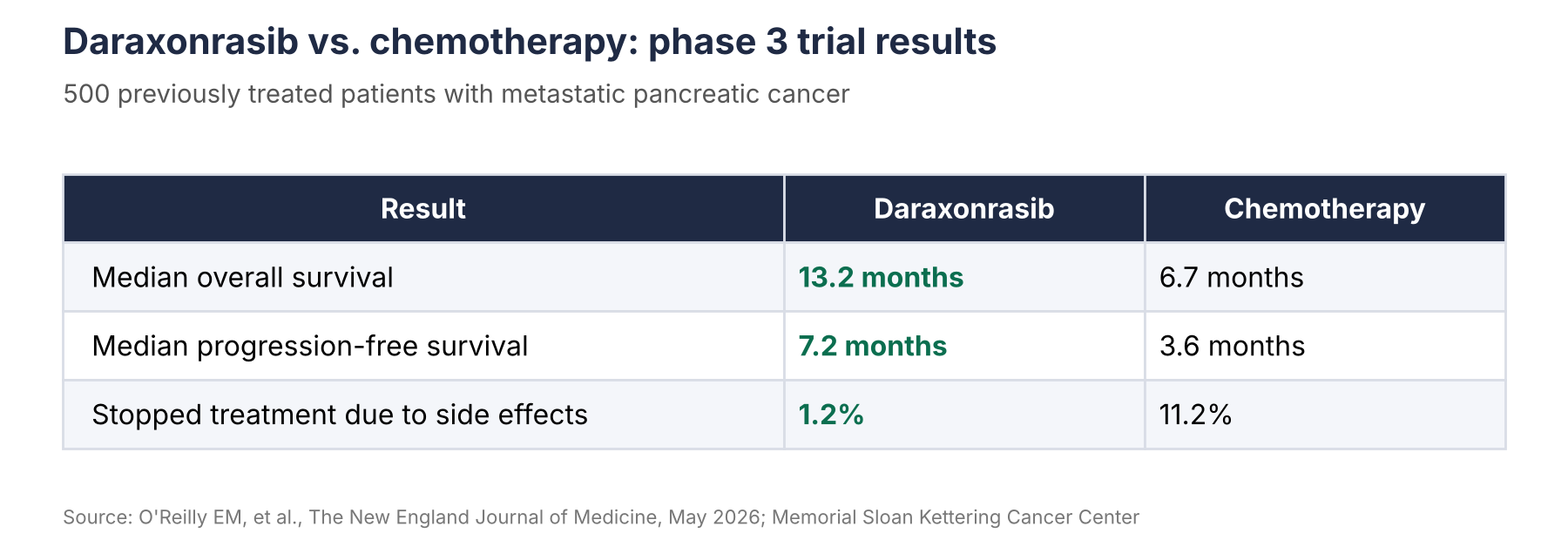
The most common side effects were skin rash and digestive problems, which were mostly manageable. The rash can be painful and inflamed, and care teams treat it with creams and help from dermatologists. Even so, patients in the trial reported it was easier to live with than the nausea and exhaustion that often come with chemotherapy.
Dr. O'Reilly was lead author of the trial results published in The New England Journal of Medicine in May 2026. She also presented the findings at the plenary session of the 2026 ASCO Annual Meeting, the largest cancer conference in the U.S.
Who can receive it, and what to ask your doctor
The FDA approved daraxonrasib for adults with metastatic pancreatic adenocarcinoma, the most common type of pancreatic cancer, who meet either of these conditions:
- Their cancer no longer responds to at least one prior treatment.
- They are not candidates for multiagent systemic therapy.
FDA approval means oncologists anywhere in the country can prescribe the drug. It also means many insurers, including Medicare, are expected to cover or help pay for it.
If you or a loved one is living with pancreatic cancer, consider asking your care team:
- Has my tumor been tested for RAS or KRAS mutations, and how long do results take?
- Am I a candidate for daraxonrasib now, or could I be later?
- What side effects should I watch for, and how will we manage them?
- Are there clinical trials I should consider?
Not a cure, but a new beginning
Daraxonrasib is not a cure, and Dr. O'Reilly describes this moment as the start of a new era rather than the finish line. Pancreatic cancer is often found only after it has spread, which makes it hard to treat.
Researchers believe the drug may work even better alongside other therapies, which could also help prevent cancer cells from developing resistance. Combinations under discussion or in early testing include:
- Immunotherapy, including vaccines designed for pancreatic cancer
- Other targeted drugs aimed at specific KRAS subtypes
- Antibody-drug conjugates
- Chemotherapy given together with daraxonrasib
- Treatment before surgery to shrink tumors, or after surgery to lower the chance of recurrence
Two new phase 3 trials at MSK are already underway. One tests daraxonrasib, alone or with chemotherapy, in people with untreated metastatic disease. Another, led by Dr. O'Reilly, tests the drug after surgery for earlier-stage disease.
We are grateful to the patients and families who joined these trials. Their participation is what makes progress like this possible for everyone who comes after them.
Sources
- Memorial Sloan Kettering Cancer Center, "FDA Approves Daraxonrasib for Pancreatic Cancer: What Patients Need To Know", by Bill Piersol, updated August 26, 2026
- U.S. Food and Drug Administration, approval announcement
- O'Reilly EM, et al., The New England Journal of Medicine, May 2026
This article is for general information and is not medical advice. Please talk with your care team about whether a treatment is right for you.